Independent research by Galen Matson
A new way
to move
between worlds.
Momentum Exchange Banks are a proposal for reusable orbital ports: shared machinery that could help ships travel through an industrial solar system.
From a single orbital port to a connected system of destinations.
01 / Momentum Exchange Banks
A research proposalA port that
throws spaceships.
What if a ship could borrow the machinery for its next maneuver?
A Momentum Exchange Bank, or MEB, is a proposed orbital port. Tethers transfer force between the bank and passing spacecraft. Large flywheels store rotational energy. Arriving traffic can return useful energy and momentum to the system.
The machinery stays in space to serve the next ship. The goal is reusable transport infrastructure for an industrial solar system.
01 / Capture
Meet the ship.
A maneuvering tetherhead matches the approaching ship and attaches to reinforced tow points. A controlled pull changes the ship’s trajectory.
Conceptual sequence. The current model studies the pull after attachment; docking and release hardware still need a coupled simulation.
Momentum has a direction.
The bank recoils when it changes a ship’s velocity. Traffic, propulsion, or other external forces must balance that impulse over time.
Rotation needs balancing.
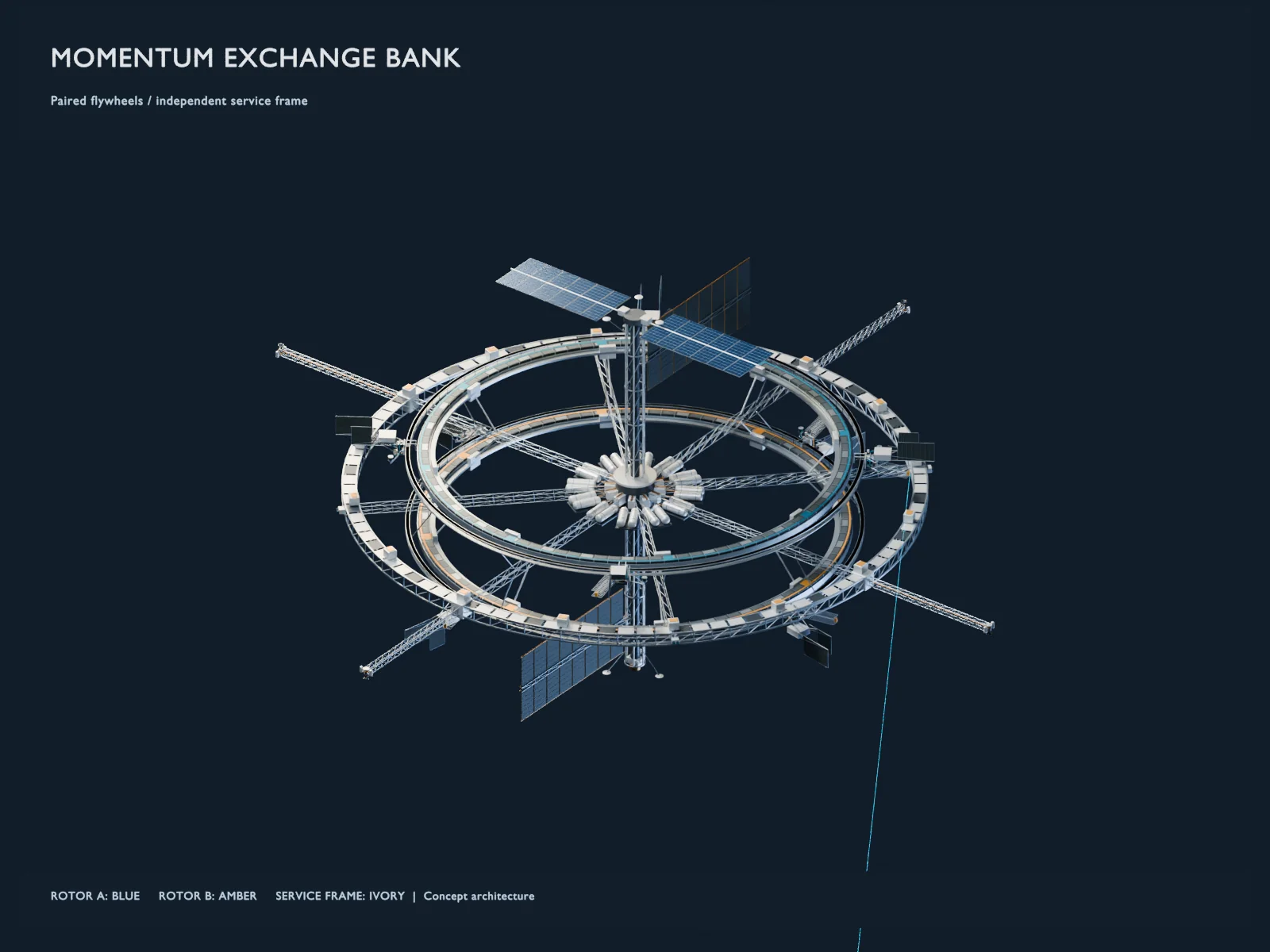
The current design uses two counterrotating flywheels, independent reels, and a service structure that carries utilities and propulsion.
Energy has a cost.
Flywheels store energy; power plants replenish it. Conversion losses and waste heat stay in the engineering budget.
On the research desk / October 2, 2026
Current design analysisTwo reels.
A short leader.
A better connection.
The big idea is becoming a collection of machines we can study.
The latest design uses two independently driven annular reels, wound in opposite directions, and two main load ribbons. Near the ship, a small pilot carries a 300-meter leader to make the first connection. Dampers settle the capture head before the structural attachments take the main load.
That separates a delicate docking problem from a very large machinery problem.
Read the current design update ↗The faster case begins at 1 km/s relative to the bank and a 1,000 km encounter radius. Its 398 m/s vector change is mostly a turn; speed decreases by about 1 m/s. This is a local encounter study, not a solved interplanetary route. A ton means 1,000 kg.
02 / The Momentum Exchange Network
One bank moves a ship.
A network opens
a solar system.
Ports connect places. Infrastructure lets them become an economy.
A Momentum Exchange Network would coordinate banks near useful destinations. Ships could travel between ports while energy, momentum, and cargo move through the larger system.
Bulk freight can favor economy. Passengers may favor speed. The interesting question is what becomes possible when every ship can share the transport machinery.
A gateway into the network.
Banks in the Earth–Moon region could connect local industry with interplanetary routes. Getting people and materials off Earth remains a separate part of the transport system.
03 / Get a feel for the scale
An illustrative calculationBig ideas.
Real bookkeeping.
Change the ship’s mass and velocity gain. Watch how the energy requirement and bank recoil respond.
Energy gained by the ship
500 TJ½ × mass × velocity²Bank recoil
1 m/sPayload-energy recharge
17.4 hoursDouble the velocity gain, and this payload energy becomes four times as large.
The assumptions behind these numbers
This example starts the ship at rest in the bank’s initial inertial frame. A ton means 1,000 kg. Bank mass is fixed at 100 million tons, with no external impulse during the short exchange. Recoil magnitude is ship momentum divided by bank mass.
Recharge assumes 10 GW of generation and 80% efficiency into useful stored energy. It covers the payload’s kinetic energy only. Bank recoil energy, tether motion, heat, additional conversion losses, and restoring the bank’s orbit require separate budgets. This is an idealized energy and impulse calculation, not a mission or travel-time simulation.
Keep going
The machinery.
The physics. The possibilities.
Start with the October 2026 design update for the current annular reels and local capture work. The original white paper develops the broader MEB concept and network; it records an earlier design direction.
Read the original paper